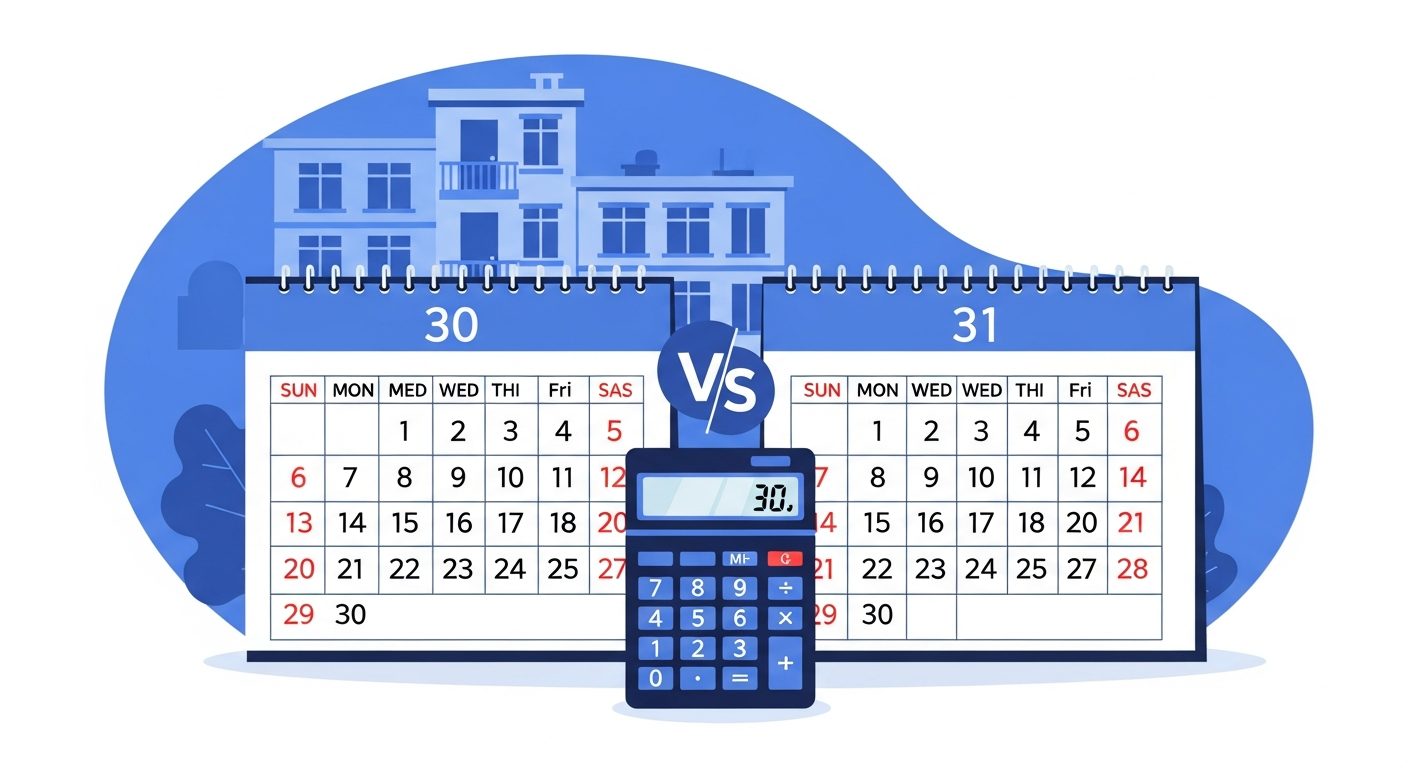
Prorated Rent: 30 or 31 Days? How to Calculate It Correctly
Prorated Rent: 30 or 31 Days? The Correct Method Explained
When you move in or out mid-month, your landlord needs to calculate prorated rent. The question that creates the most disputes: do you divide by 30 days or by the actual number of days in that month?
The short answer is: it depends on what method your lease specifies; and the actual-days method is generally more accurate and more defensible.
Here's how each method works, when to use which, and how to calculate your prorated rent correctly.
The Two Main Methods for Prorating Rent
Method 1: Actual Days in the Month (Recommended)
Formula:
Monthly Rent ÷ Actual Days in Month × Days Occupied = Prorated Rent
Example: Moving in on March 15th, rent is $1,800/month.
- March has 31 days
- Days occupied: 17 (March 15-31)
- Daily rate: $1,800 ÷ 31 = $58.06/day
- Prorated rent: $58.06 × 17 = $987.10
Example for February: Moving in on February 10th, rent is $1,800/month.
- February has 28 days (non-leap year)
- Days occupied: 19 (Feb 10-28)
- Daily rate: $1,800 ÷ 28 = $64.29/day
- Prorated rent: $64.29 × 19 = $1,221.43
Method 2: 30-Day Month (Simplified)
Formula:
Monthly Rent ÷ 30 × Days Occupied = Prorated Rent
Same example: Moving in on March 15th, rent is $1,800/month.
- Daily rate: $1,800 ÷ 30 = $60.00/day
- Prorated rent: $60.00 × 17 = $1,020.00
Notice that Method 2 gives you $1,020 while Method 1 gives you $987. For March (a 31-day month), the 30-day method favors the landlord. For February, the 30-day method favors the tenant.
Which Method Is Correct?
Neither method is universally "correct"; but:
The actual-days method is more accurate because it reflects how many days are actually in the billing period. Most courts and accountants consider this the defensible standard.
The 30-day method is simpler and produces a consistent daily rate year-round. It's widely used and courts accept it; if it's specified in the lease.
The rule: Whatever your lease says controls. If the lease is silent, the actual-days method is the default in most jurisdictions.
Does It Matter Whether the Month Has 30 or 31 Days?
Yes; but not always in the way people expect:
| Month | Days | Method 1 Daily Rate | Method 2 Daily Rate | Who Benefits |
|---|---|---|---|---|
| January | 31 | $1,800 ÷ 31 = $58.06 | $1,800 ÷ 30 = $60.00 | Tenant (Method 1 is lower) |
| February | 28 | $1,800 ÷ 28 = $64.29 | $1,800 ÷ 30 = $60.00 | Landlord (Method 2 is lower) |
| March | 31 | $58.06 | $60.00 | Tenant |
| April | 30 | $60.00 | $60.00 | Equal |
| May | 31 | $58.06 | $60.00 | Tenant |
| June | 30 | $60.00 | $60.00 | Equal |
Based on $1,800/month rent.
For 31-day months, the actual-days method gives tenants a lower daily rate (and thus less prorated rent to pay). For February, it gives tenants a higher daily rate; which is why some landlords prefer the 30-day method in February.
Bottom line: In a 31-day month, use actual days; it's more accurate and benefits tenants. In February, the 30-day method may slightly favor tenants if their lease is silent.
How to Calculate Prorated Rent: Step by Step
For Moving In
- Find your rent due date and move-in date
- Count the number of days you'll occupy the unit in that first month (include your move-in day)
- Divide your monthly rent by the actual number of days in that month
- Multiply by the number of days you'll occupy
Example: Moving in June 20th, rent $2,200/month
- June has 30 days
- Days occupied: 11 (June 20-30)
- Daily rate: $2,200 ÷ 30 = $73.33
- Prorated first month: $73.33 × 11 = $806.67
For Moving Out
- Find your move-out date
- Count the days you occupied the unit in the final month (include the move-out date if you had possession that day, or the day before if keys were returned)
- Divide monthly rent by days in that month
- Multiply by occupancy days
Example: Moving out August 18th, rent $1,500/month
- August has 31 days
- Days occupied: 18 (August 1-18)
- Daily rate: $1,500 ÷ 31 = $48.39
- Final month rent: $48.39 × 18 = $870.97
Use the prorated rent calculator to get the exact number for your move-in or move-out date instantly.
Move-Out Prorate Calculator: When You Leave Mid-Month
The same formula applies whether you're calculating prorated rent for move-in or move-out. The key question is: which day are you counting to?
For move-out, use the last day you have legal possession of the unit:
- If you return keys on the 18th: count through the 17th (you gave up possession)
- If your lease formally ends on the 18th: count through the 18th
Different landlords handle this differently. Check your lease for the exact language, and confirm in writing before move-out.
Move-out prorate example (leaving the 10th of March):
- Monthly rent: $1,800
- March has 31 days
- Daily rate: $1,800 ÷ 31 = $58.06
- Days occupied: 10 (March 1-10)
- Prorated rent: $58.06 × 10 = $580.65
Proration Calculator: 30 Days vs. Actual Month: Which to Use?
Use this quick decision guide:
| Situation | Which Method |
|---|---|
| Lease specifies "divide by 30" | 30-day method |
| Lease specifies "actual days in month" | Actual-days method |
| Lease is silent | Actual-days method (default) |
| Dispute with landlord | Actual-days method (stronger legal position) |
| Short-term rental or AirBnB | 30-day method is often used |
If your landlord proposes the 30-day method but your lease doesn't specify it, you can request the actual-days method, especially for 31-day months where it benefits you.
Does It Matter Whether a Month Has 28, 29, 30, or 31 Days?
For the actual-days method: Yes, it matters every month.
- February (28 days): highest daily rate of any month
- February in a leap year (29 days): slightly lower
- April, June, September, November (30 days): middle rate
- January, March, May, July, August, October, December (31 days): lowest daily rate
For the 30-day method: No, it doesn't matter; the daily rate is always the same: Monthly Rent ÷ 30.
The practical impact: On a $2,000/month apartment, the difference between a 28-day and 31-day month is:
- 28 days: $71.43/day
- 31 days: $64.52/day
That's a $6.91 per day difference. For a 15-day move-in, that's a $103 swing depending on which month you move.
When Both Landlord and Tenant Calculate Different Numbers
If your landlord's proration and your calculation don't match, here's what to check:
- Which method did they use? Ask. Get it in writing.
- Did they count the right days? Did they include or exclude your move-in/move-out date?
- Does your lease specify a method? If so, that controls.
- Did they use the right month? Make sure they're dividing by the correct number of days.
Most disputes are arithmetic errors, not intentional overcharges. Run the numbers with our prorated rent calculator and share the output with your landlord if there's a discrepancy.
State Rules on Prorated Rent
Most states don't have a specific law requiring a particular proration method; it's left to the lease. A few notable exceptions:
California: No specific law on proration method, but the state's consumer protection principles (Civil Code §1750+) give courts authority to resolve disputes in favor of the clearer interpretation. Actual-days is generally preferred.
New York: No specific proration statute. Lease governs.
Texas: No proration law. Actual-days is standard by custom.
Florida: No proration law. Courts have used both methods.
For most states, if your lease is silent, you have a reasonable argument for actual-days. If your landlord insists on 30-days for February (which costs you more), push back.
Frequently Asked Questions
Do you prorate rent for 30 or 31 days?
Use the actual number of days in the month unless your lease specifies 30. For 31-day months like March, July, or January, dividing by 31 gives the tenant a lower daily rate (less to pay). For February, the 30-day method may favor tenants.
How do you calculate the daily rate for prorated rent?
Monthly rent ÷ number of days in the move-in/out month = daily rate. Then multiply by days occupied.
What if I move in on the 1st: is rent still prorated?
No. If you move in on the 1st (when rent is typically due), you owe a full month's rent. Proration only applies when you take possession mid-month.
Does the last day of the month count as a day of occupancy?
If you have legal possession through the end of the month, yes. If you return keys early, your last occupancy day is typically the day before key return.
What is a move-out prorate calculator?
The same formula used for move-in; monthly rent ÷ days in final month × days occupied. You can use the prorated rent calculator for both move-in and move-out calculations.
Use the prorated rent calculator to calculate your exact proration for any move-in or move-out date, using either the actual-days or 30-day method.